Automated Gating System Optimization Using Casting Simulation Improved Casting Quality and Reduced Development Time
ABSTRACT
The increasing demand for high-quality, cost-effective, and lightweight cast components has created a need for faster product development and optimized manufacturing processes. In High Pressure Die Casting (HPDC), the gating system plays a critical role in controlling molten metal flow, ensuring proper cavity filling, achieving consistent casting quality, and minimizing casting defects. The design of the gating system directly influences important process characteristics such as metal flow velocity, filling pattern, turbulence, solidification behavior, and defect formation.
Conventional gating system design is often based on empirical guidelines, designer experience, and multiple shop-floor trials. This can increase product development time, tooling costs, material utilization, and the risk of inconsistent casting quality. Casting simulation provides an effective method for evaluating and improving gating designs before physical trials. However, conventional simulation-based optimization may still require engineers to manually create and evaluate multiple design alternatives, which can be time-consuming when several gating parameters need to be optimized.
This paper presents a simulation-based automated gating system optimization approach for an HPDC component. A parametric optimization methodology was implemented by systematically varying selected in gate parameters and evaluating each design through casting simulation. The optimization process considered the influence of gate geometry on metal flow characteristics, filling behaviour, velocity distribution, turbulence, and overall casting quality. Multiple design iterations were performed automatically to identify an optimized gate configuration while maintaining complete cavity filling and stable metal flow. The methodology reduces dependence on conventional trial-and-error methods, supports systematic evaluation of multiple design alternatives, improves the potential for first time right development, and can significantly reduce product development time and tooling modification requirements.
Keywords: Casting Simulation, Automated Gating Optimization, Gating System Design, Yield Optimization, Process Parameter Optimization, Defect Reduction.
INTRODUCTION
High Pressure Die Casting (HPDC) is one of the most widely used manufacturing processes for producing complex, thin-walled, and dimensionally accurate metal components at high production rates. The process is extensively employed in the automotive, aerospace, electrical, and consumer goods industries due to its ability to manufacture lightweight components with excellent surface finish, close dimensional tolerances, and high repeatability. With the increasing demand for lightweight vehicles, electric mobility, and cost-effective manufacturing, HPDC has become the preferred process for producing Aluminium and magnesium alloy components such as transmission housings, engine covers, structural brackets, motor housings, and battery enclosures.
The quality of an HPDC casting is highly dependent on the design of the gating system and thermal balancing. The gating system serves as the pathway through which molten metal enters the die cavity and directly influences metal flow behavior, cavity filling sequence, flow velocity, turbulence, heat transfer, and solidification characteristics. An optimally designed gating system ensures smooth and balanced filling of the cavity while minimizing casting defects and maximizing production efficiency. Conversely, an improperly designed gating system can result in non-uniform filling, excessive turbulence, premature solidification, and the formation of casting defects that adversely affect component performance.
AUTOMATED GATING SYSTEM DESIGN:
1.Limitations of Conventional Gating Design:
The design of a gating system is one of the most critical stages in the development of High Pressure Die Casting (HPDC) components. Traditionally, gating systems are designed using empirical design guidelines, foundry standards, and the practical experience of process engineers. Although these methods have been widely adopted in the casting industry, they largely depend on trial-and-error approaches to achieve acceptable casting quality.
In a conventional workflow, engineers manually modify gate dimensions, runner geometry, and gate locations based on simulation results or shop-floor observations. Each design modification requires regeneration of the CAD model, execution of a new casting simulation, evaluation of results, and further design changes if the desired quality is not achieved. This iterative process consumes significant engineering time and increases the overall product development cycle.
For components with complex geometries, numerous design variables influence molten metal flow behaviour. Since only a limited number of design alternatives can be evaluated manually, the final design often represents a satisfactory solution rather than the optimum one.
2.Role of Casting Simulation in Gating Design
Casting simulation has transformed the product development process by enabling engineers to evaluate mold filling and solidification behaviour before manufacturing the die.
Simulation predicts important process parameters such as:
- Metal flow pattern
- Filling sequence
- Metal filling velocity
- Temperature distribution
- Air entrapment
- Shrinkage porosity
- Solidification behavior
- Stress in casting after solidification
- Warpage/ contraction.
These predictions allow engineers to identify potential casting defects during the design stage, thereby reducing dependence on physical trials. However, casting simulation alone does not automatically identify the best gating design. Engineers must still manually modify the design and perform repeated simulations until satisfactory results are obtained.
3.Need for Automated Gating Optimization:
The increasing complexity of cast components and stringent product development expectations have created the need for automated gating optimization.
Automated gating optimization combines parametric CAD models with casting simulation to evaluate multiple gating automatically. Instead of manually modifying one design parameter at a time, the optimization algorithm systematically varies predefined parameters such as:
- Gate width
- Gate thickness
- Gate location
- Runner dimensions
- Gate cross-sectional area
- Overflow locations and dimensions.
Each design alternative is automatically analysed using mold filling simulation, and its performance is evaluated against predefined optimization objectives such as minimizing air entrapment and improving casting quality.
Because multiple design iterations are analysed without manual intervention, automated optimization enables engineers to identify the optimum gating configuration much more efficiently than conventional approaches.
4.Benefits of Automated Gating Design
- Improved Casting Quality: Automated optimization identifies the gate configuration that provides smoother metal flow and reduced turbulence, resulting in lower air entrapment and improved casting quality.
- Reduced Development Time: Multiple gate designs are evaluated automatically, eliminating repetitive manual CAD modifications and simulation setup. This significantly shortens the product development cycle.
- Reduced Tooling rework: Since the optimized design is obtained before tool manufacturing, the need for die rework and tooling modifications is minimized, reducing manufacturing cost.
- Increased Engineering Productivity: Engineers spend less time generating design variants and more time analysing optimization results, improving overall engineering efficiency.
- Objective Decision Making: The optimization process evaluates all candidate designs using quantitative simulation results rather than engineering intuition, resulting in consistent and repeatable decisions.
- Better Design Space Exploration: Unlike manual optimization, which evaluates only a few alternatives, automated optimization can investigate dozens or hundreds of gating configurations, increasing the probability of identifying the best solution.
CASE STUDY ON AUTOMATED GATING OPTIMIZATION:
In this case study we are going to demonstrate automated gating optimization using ADSTEFAN casting simulation software by Hitachi ICS Japan and inputs and outputs through simple geometry as defined below:
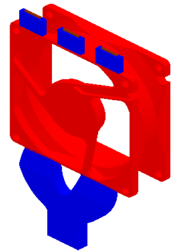
Fig 1: Case study model considered
Process is HPDC and material is Alloy Al- ADC 12 grade selected.
For shape optimization we have used SolidWorks® is a registered trademark and copyrighted software owned by Dassault Systems and for Simulation we have used ADSTEFAN® is owned and copyrighted by Hitachi Industry & Control Solutions, Ltd. And CAO (Computer Aided Optimization) software – FxLooper® registered trademark and copyrighted software owned by “Another Worker Co., Ltd.”
Shape variable definition:
In this case study we are going to study shape variables of ingate which directly impact quality of casting.
Current ingate dimensions are 23 mm (Width Left and Right) and they are apart by 18.3 mm (Center Left and Right) from center of gating. For ingate shape variable we have defined as per below:
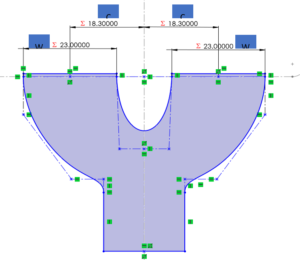
Fig 2: Ingate shape variable
Below are our set design parameters, Objective function and DOE:
- Design Parameters: Ingate length and distance of ingate from center.
- Objective function: Entrained air volume and air contact time to be minimum,
- Design of experiments (Optimization methods): Latin hyperquadral sample design, Bayesian optimization
Considering above Objectives, design parameters of ingate are set as below table:
|
|
Min | Max |
| Ingate 1 length (Width Left) | 5 | 35 |
| Ingate 1 (distance from center left) | 5 | 35 |
| Ingate 2 length (Width Right) | 5 | 35 |
| Ingate 2 (distance from center right) | 5 | 35 |
TABLE 2: Ingate Shape variable considered.
In ADSTEFAN we have set conditions as minimum air entrapment in casting and for optimization techniques selected Latin hyperquadral sample design, Bayesian optimization with sample of 100 variables.
Results and Observations:
By providing above inputs we have executed 100 samples – flow analysis and computation time taken for all simulation is around 46 minutes and below are results after evaluation.
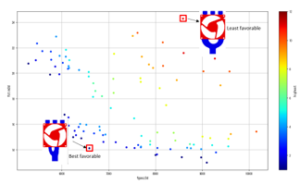
Fig 3: Results of Shape optimization
From above image we have observed Case 63 has least air entrapment with respect to gas entrapped in casting as per below figure along with Ingate cad model.
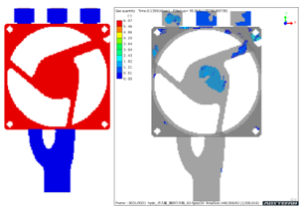
Fig 4: Ingate geometry with least gas entrapment.
We have also determined that Case 31 has highest air entrapment with respect to gas entrapped in casting as per below figure along with Ingate cad model.
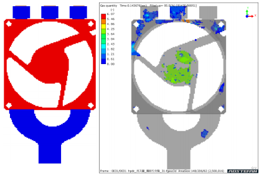
Fig 5: Ingate geometry with highest gas entrapment.
CONCLUSION:
This paper presented a simulation-driven automated gate optimization methodology for controlling air entrapment in a High Pressure Die Casting (HPDC) component. By integrating automated parametric gate design with casting simulation, multiple gating design were systematically evaluated to identify the optimum design based on mold filling behavior and predicted casting defects.
The study highlights the advantages of automated gating optimization over conventional trial-and-error design practices by providing a faster and systematic approach to gating system development. In addition to improving casting quality, the methodology reduces tooling modifications, enhances design consistency, and achieving a first time-right gating design. The proposed approach demonstrates the potential of simulation-driven optimization as an effective tool for modern foundries seeking to improve process efficiency and reduce product development costs. Furthermore, the methodology can be extended to optimize additional quality objectives such as shrinkage porosity, casting yield, and thermal balance supporting the adoption of digital manufacturing and Industry 4.0 practices in the metal casting industry.
Recent Posts
- Gating System Design in Sand Casting and Its Impact on Casting Quality
- Virtual Casting Trials vs. Physical Shop-Floor Trials: The Smarter Approach to Casting Development
- Automated Gating System Optimization Using Casting Simulation Improved Casting Quality and Reduced Development Time
- Common Casting Defects in Lost Foam Casting Process and How to Overcome Them
- Common Defects in Centrifugal Casting Process and How to Overcome Them
- Common Defects in Low Pressure Die Casting Process and How to Overcome Them
- Common Defects in Shell Molding Process and How to Overcome Them
- Common Casting Defects in Investment Casting and How to Overcome Them
- Common Defects in GDC Process and How to Overcome Them
- Common Casting Defects in HPDC and How to Overcome Them