Virtual Casting Trials vs. Physical Shop-Floor Trials: The Smarter Approach to Casting Development
Introduction
Developing a high-quality casting involves several engineering decisions, including casting design, gating system development, riser positioning, pouring parameters and solidification. Traditionally, these decisions are validated through physical shop-floor trials, where multiple iterations are often required to achieve the desired casting quality.
However, repeated physical trials can consume significant amounts of time, raw materials, energy and manufacturing resources. In today’s competitive manufacturing environment, foundries are increasingly adopting casting simulation technology to evaluate and optimize casting processes before committing to actual production.
Virtual casting trials, supported by advanced casting simulation software, provide engineers with the ability to visualize metal flow, predict solidification behaviour and identify potential defects during the development stage.
So, how do virtual casting trials compare with conventional physical shop-floor trials? And why is combining both approaches becoming a smarter strategy for modern casting development?
Understanding Physical Shop-Floor Trials
Physical shop-floor trials are the conventional approach to validating a casting process. Engineers prepare the mould, gating system and feeding arrangement based on their experience, calculations and established manufacturing practices.
Molten metal is poured into the mould, and the resulting casting is inspected to evaluate its quality.
If defects such as shrinkage porosity, gas porosity, cold shuts, misruns or inclusions are identified, modifications are made to the gating system or process parameters. The process is then repeated until acceptable casting quality is achieved.
Challenges associated with repeated physical trials:
- High material consumption: Every trial requires molten metal, mould preparation and other consumables.
- Longer development time: Repeated modifications and production cycles can delay component development.
- Increased manufacturing cost: Additional labour, energy, tooling modifications and material usage increase development expenses.
- Limited visibility: Internal metal flow and solidification behaviour cannot be directly observed during actual pouring.
- Trial dependency: The development process may depend heavily on individual experience and repeated experimental validation.
Physical trials remain essential for confirming actual manufacturing performance, but relying exclusively on them can make casting development time-consuming and resource intensive.
Understanding Virtual Casting Trials Using Simulation
Virtual casting trials use advanced computer simulation technology to replicate the casting process in a digital environment.
Before actual mould preparation and pouring, engineers create a 3D model of the casting, gating system, risers. The casting simulation software evaluates the filling and solidification processes using defined material properties and process parameters.
Engineers can study:
- Molten metal filling patterns and flow behaviour.
- Metal velocity and turbulence during filling.
- Air entrapment and potential gas-related defects.
- Temperature distribution throughout the casting.
- Solidification pattern and solidification time.
- Hot spots and potential shrinkage porosity locations.
- Thermal stress and potential crack formation
Based on simulation results, engineers can modify the gating system, riser dimensions, pouring conditions and other process parameters before conducting physical trials.
This enables multiple design iterations to be evaluated virtually, helping identify a more suitable casting process before moving to actual production.
Virtual Casting Trials vs. Physical Shop-Floor Trials
Both approaches play important roles in casting development. However, they differ in terms of evaluation methods, resources and the stage at which process improvements can be identified.
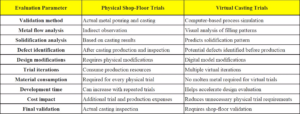
The key advantage of simulation is not replacing physical trials, but making every physical trial more informed and purposeful.
How Casting Simulation Improves the Development Process
Casting simulation supports engineers at different stages of casting development.
1.Gating System Optimization
The gating system controls how molten metal enters and fills the mould cavity. Improper gating design can result in turbulence, air entrapment, inclusions and other filling-related defects.
Using simulation, engineers can evaluate different gating configurations, ingate locations, runner dimensions and metal flow conditions.
This helps identify a suitable gating arrangement that supports controlled filling and improved casting quality.
2.Identification of Potential Casting Defects
One of the major advantages of casting simulation is the ability to predict potential defect locations before manufacturing the actual casting.
Depending on the simulation capabilities and input data, engineers can investigate:
- Shrinkage porosity.
- Gas porosity and air entrapment.
- Cold shuts and misruns.
- Oxide inclusions and flow-related defects.
- Hot spots and non-directional solidification.
- Thermal stress and crack-related risks.
Early identification allows engineers to take corrective action during the design and methoding stage rather than after production.
3.Process Parameter Evaluation
Pouring temperature, mould temperature, pouring time, material properties and cooling conditions influence casting quality.
Virtual trials allow engineers to evaluate the effect of different process parameters and identify optimum operating conditions before implementing them on the shop floor.
The Importance of Combining Virtual and Physical Trials
Although casting simulation provides valuable insights into the casting process, it should not be considered a complete replacement for physical shop-floor validation.
Actual casting behaviour can be influenced by several practical factors, including variations in material composition, mould properties, pouring conditions, operator practices and production equipment.
Therefore, the most effective approach is to integrate virtual casting trials with controlled physical validation.
Business Benefits for Foundries
The adoption of virtual casting trials can deliver benefits beyond technical improvements.
- Reduced Development Cost: Minimizing unnecessary physical trials helps reduce expenditure on molten metal, mould preparation, energy and labour.
- Faster Product Development: Multiple virtual iterations can be performed before committing to physical manufacturing, supporting shorter development cycles.
- Improved Casting Yield: Better gating and feeding arrangements can reduce excess metal consumption and improve yield.
- Better Quality Control: Early identification of potential defects supports preventive engineering rather than corrective action after production.
- Knowledge-Based Decision Making: Simulation results provide a visual and analytical foundation for engineering decisions, helping reduce dependence on trial-and-error methods.
Conclusion
The future of casting development lies in combining engineering experience with digital manufacturing technologies.
Physical shop-floor trials will always remain important for validating actual production performance. However, conducting repeated trials without prior engineering evaluation can result in unnecessary expenditure, longer development cycles and increased resource consumption.
Virtual casting trials provide an opportunity to understand metal flow, solidification behaviour and potential defects before actual production begins. By integrating casting simulation into the development process, foundries can make more informed decisions, optimize methoding designs and improve manufacturing efficiency.
The smarter approach is not to eliminate physical trials, but to reduce unnecessary trials through simulation-based engineering.
With advanced casting simulation solutions such as ADSTEFAN, foundries can move towards a more predictable, efficient and quality-driven casting development process.
Recent Posts
- Gating System Design in Sand Casting and Its Impact on Casting Quality
- Virtual Casting Trials vs. Physical Shop-Floor Trials: The Smarter Approach to Casting Development
- Automated Gating System Optimization Using Casting Simulation Improved Casting Quality and Reduced Development Time
- Common Casting Defects in Lost Foam Casting Process and How to Overcome Them
- Common Defects in Centrifugal Casting Process and How to Overcome Them
- Common Defects in Low Pressure Die Casting Process and How to Overcome Them
- Common Defects in Shell Molding Process and How to Overcome Them
- Common Casting Defects in Investment Casting and How to Overcome Them
- Common Defects in GDC Process and How to Overcome Them
- Common Casting Defects in HPDC and How to Overcome Them