Transforming Casting Quality Through Casting Optimization and Casting Simulation Technologies
In today’s highly competitive manufacturing environment, foundries are under constant pressure to improve casting quality, reduce production costs, minimize defects, and reduce product development cycles. Traditional trial-and-error approaches often lead to excessive raw material utilization, longer lead times, and higher rejection rates. As a result, advanced foundry software has become an essential tool for achieving consistent and efficient casting production.
Modern simulation-driven engineering enables foundries to optimize every stage of the casting process—from mold filling and solidification before actual shop floor trials. This digital approach significantly enhances productivity while reducing risk and development costs.
Enhancing Quality with Mold Filling Simulation
The initial stage of the casting process significantly influences the final product quality. Improper mold filling can result in defects such as cold shuts, misruns, air entrapment, sand erosion, oxide inclusions, and turbulence-related issues.
Mold filling simulation provides detailed visualization of molten metal flow inside the mold cavity. Engineers can analyze:
- Flow patterns
- Metal velocity
- Temperature distribution
- Air entrapment
- Turbulence levels
- Filling time
By understanding these parameters before production, foundries can optimize gating systems and process conditions to achieve smooth and defect-free mold filling.
The result is improved casting quality, reduced scrap rates, and higher process reliability.
Achieving Defect-Free Castings Through Solidification Simulation
While mold filling determines how metal enters the cavity, the solidification stage dictates the final internal quality of the casting.
Solidification simulation helps engineers predict:
- Shrinkage porosity
- Hot spots
- Feeding behavior
- Solidification pattern
- Thermal gradients
- Residual stresses after solidification
Using advance solidification simulation, engineers can optimize riser locations, chills, insulation blankets, and process parameters to ensure directional solidification and proper feeding.
By identifying potential defects virtually, foundries can eliminate costly shop-floor trials and significantly improve first-time-right casting production.
The Need for Casting Optimization
Casting optimization is the process of improving casting design and manufacturing parameters to achieve defect-free components with maximum yield. Through casting simulation-based analysis, foundries can evaluate multiple gating and process conditions virtually and identify the optimized gating and process parameters before shop-floor implementation.
Benefits of casting optimization include:
- Reduced casting defects and rework costs.
- Improved casting yield
- Lower raw material and energy consumption
- Faster product development
- Enhanced casting quality and reliability
- Reduced production costs
By integrating advanced casting simulation such as ADSTEFAN into the development process, foundries can make informed engineering decisions based on data rather than assumptions and experience.
Importance of Riser Design Optimization
One of the most critical aspects of producing sound castings is effective feeding during solidification. Poor riser design often leads to shrinkage porosity, low yield, and increased production costs and reworks.
Riser design optimization helps engineers determine the optimal size, shape, and location of risers to ensure adequate feeding throughout the solidification process. Modern foundry software enables virtual evaluation of multiple riser configurations, allowing engineers to:
- Eliminate shrinkage defects
- Improve casting soundness
- Increase casting yield
- Reduce excess metal consumption
- Lower machining and finishing costs
Case study:
We have considered an Alloy wheel casting of A356 material, as shown in figure 1 which is produced through gravity die casting (GDC) process. Weight of Alloy wheel is 13 Kgs and along with initial gating design, Bunch weight of casting is 20.86 Kgs with Yield 62.32 %.

Figure 1: Alloy wheel for 4-wheeler Passenger Vehicle
In Case 2, 25% of center hub riser is reduced and thus total bunch weight obtained is 18.89 Kgs with yield 68.81% and in Case 3, 20% of center hub riser is reduced and bunch weight of Case 3 is 19.29 Kgs with yield 67.3 %. All the three cases were simulated using ADSTEFAN casting simulation software.
Below are results of solidification analysis for simulations performed. As observed, there isolation in solidification for Case 2.
| Casting Weight in Kgs | Bunch Weight in Kgs | Yield % | Remarks | Observation | |
| Case 1 | 13 | 20.86 | 62.32 | Riser size of Dia – 72 mm and Height – 193 mm | Over feeding of riser is observed |
| Case 2 | 13 | 18.89 | 68.81 | Riser Weight reduced by 25% (Height reduced to 163 mm) from Case 1 | Underfeeding of riser and will lead to shrinkage in hub area |
| Case 3 | 13 | 19.29 | 67.3 | Riser Weight reduced by 20% (Height reduced to 168 mm) from Case 1 | Optimized riser feeding observed with improvement in Yield and defect free casting |
This indicates the length of riser used is far less than required factor of safety thus leads to shrinkage porosity defect at hub area which is a very critical location. Whereas in Case 3 with 20 % of reduction of riser, we are still achieving directional solidification, and the factor of safety is on higher side compared to Case 2.
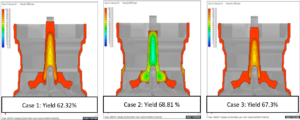
Figure 2: Solidification behavior of Alloy wheel component with 3 different Methoding designs using ADSTEFAN casting simulation.
From results shown in figure 2, considering factor of safety Case 3 is best Methoding design and yield improvement for Alloy wheel component is optimized from 62.32% to 67.3 % saving raw material utilization and energy cost.
Using Casting simulation software, foundries can perform Gating optimization and parameter optimization virtually, identifying potential casting defect and remedies before physical production begins. In this case study yield was increased by about 5% without compromising on the casting quality and without any additional investment in process controls.
The Role of Advanced Foundry Software in Digital Manufacturing
Today’s leading foundry software platforms integrate mold filling simulation and solidification simulation into a unified environment. This comprehensive approach enables engineers to evaluate the complete casting process digitally before production.
Key advantages include:
- Virtual process validation
- Reduced shop-floor trials
- Faster design iterations
- Improved productivity
- Optimized casting yield
- Better quality control
- Reduced sample submission time.
By leveraging advanced simulation technologies, foundries can transition from reactive problem-solving to proactive process optimization.
Conclusion
The future of casting manufacturing lies in casting simulation-driven engineering. Technologies such as Riser Design Optimization, Casting Optimization, Mold Filling Simulation and Solidification Simulation are empowering foundries to achieve higher quality, improved productivity, and greater profitability.
As casting complexity continues to increase, investing in advanced Foundry Software is no longer a competitive advantage—it is becoming a necessity. Foundries that embrace digital simulation technologies can significantly reduce defects, improve yield, reduce product development, and build a sustainable path toward manufacturing excellence.
Recent Posts
- Common Casting Defects in Lost Foam Casting Process and How to Overcome Them
- Common Defects in Centrifugal Casting Process and How to Overcome Them
- Common Defects in Low Pressure Die Casting Process and How to Overcome Them
- Common Defects in Shell Molding Process and How to Overcome Them
- Common Casting Defects in Investment Casting and How to Overcome Them
- Common Defects in GDC Process and How to Overcome Them
- Common Casting Defects in HPDC and How to Overcome Them
- Common Casting Defects in Sand Casting and How to Overcome Them
- Common Casting Defects and How to Overcome Them
- Why Metal Casting Simulation is Becoming Essential for Modern Foundries